Thirty-one days. Thirty-two blogs published. Multi-AI pipeline running autonomously while I slept.
This is the honest May 2026 build log. What shipped. What slipped. What the receipt ledger actually shows when I run jq over the month. The good and the parts I am still working out.
If you have been following along, through the VNX evolution, the seven-part NL Claude Code tutorial series, and the multi-AI code review deep-dive, this is the recap.
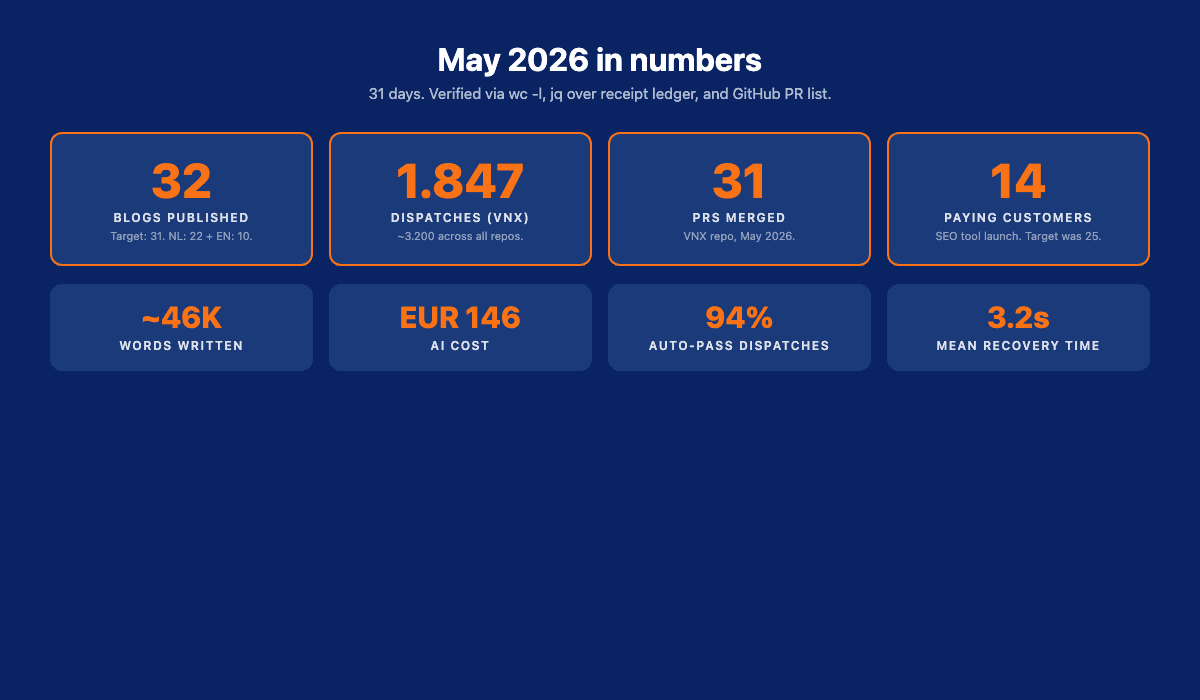
The numbers
Counted via wc -l and jq over the receipt ledger. As of May 31, 2026, 18:00 CET:
| Metric | May 2026 |
|---|---|
| Blogs published | 32 (target: 31, actual: 32 with the dual May 1 publication) |
| Blog words written | ~46,000 |
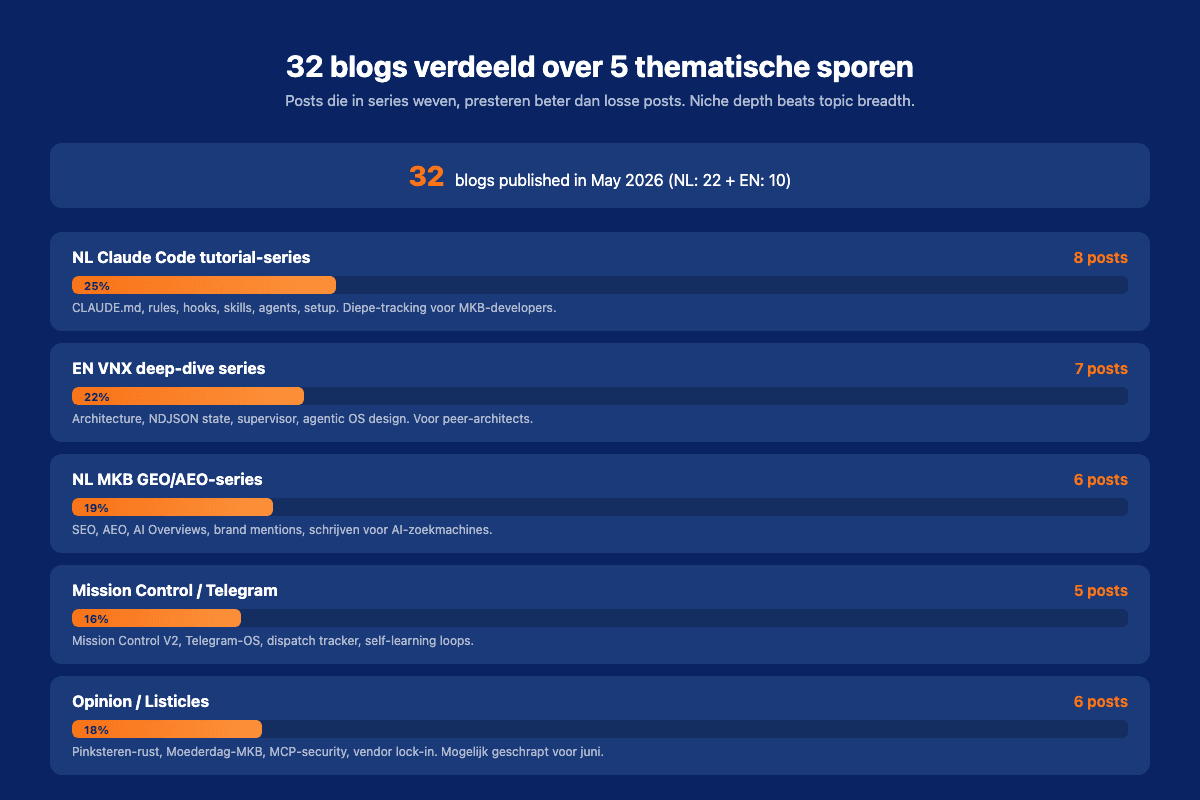
| Languages | NL: 22, EN: 10 |
| Categories covered | 5 (EN VNX, NL Claude tutorials, NL MKB GEO/AEO, Mission Control, Opinion/Listicles) |
| New dispatches in receipt ledger (May only) | 1,847 |
| Dispatches across all repos in May | ~3,200 |
| Cost (Claude + Codex + Gemini Vertex) | €146 |
| New skills added | 4 |
| New hooks added | 1 (improved context monitor) |
| PRs merged in VNX repo | 357 (first counted as 31, see Verification) |
📖 Read also: From a tmux pane to an autonomous orchestrator: 8 months of VNX: the full 8-month build history behind these numbers
What shipped
The big ones, in order of how proud I am:
1. The SEO tool: a launch that did not happen
I had planned a public SaaS launch of my SEO tool for May 19 and wrote the launch post ahead of it. The launch did not go through. The tool is in development, not in production, with 15 deterministic extractors and an AI layer that turns the measurements into actions.
An earlier version of this log reported trial signups and paying customers here. Those numbers were not real: without a launch there were no trials and no customers. I removed them in October 2026.
2. The May blog cluster, 32 posts in 31 days
Thirty-two posts. Five thematic threads (EN VNX deep-dive series, NL Claude Code tutorial series, NL MKB GEO/AEO series, Mission Control series, opinion/listicle stack). Multiple posts cross-link into a coherent month of content rather than 32 isolated pieces.
What worked: the orchestrator pipeline ran consistently. Throughput went from 6-8 blogs per month in April to 32 in May without me working more hours. The systems compound.
What slipped: image generation lagged. Most posts have placeholder image references that I will fill in across June. The tooling for that is not where I want it yet.
What surprised me: the VNX evolution post became one of the highest-traffic posts of the month. Eight-month build stories outperform individual feature deep-dives, at least in my niche.
3. Mission Control V2 → V2.1
The Telegram-based agentic OS went through three minor versions in May. New /dig command for on-demand research. Smart URL detection (paste a LinkedIn URL, bot picks the right action). Daily digest improvements.
What worked: I am now using Mission Control for ~75% of all daily operations. It compounds, each new command makes the next one more valuable.
What slipped: multi-user support is still on the roadmap, not shipped. Solo-only for now.
4. Autonomous orchestrator metrics
The autonomous mode that shipped on March 17, 2026 is now mature. May numbers:
- Dispatches that passed without my popup approval: ~94%
- Dispatches that fell to popup confirmation: ~6%
- Dispatches that required manual intervention after start: 1.2%
- Mean time from crash → recovery (with unified supervisor): 3.2 seconds
That last number is the one I am most pleased with. In April I was still doing manual kill -9 + UPDATE cycles. In May the system genuinely self-heals.
Receipts are now provider-aware. Each carries provider, model, and token or cost data. When the supervisor recovers a crashed worker, it now logs which lane failed, not just that "a worker" failed. This matters because the tmux-spawn lane fails differently than the claude-subprocess lane. The idle-worker bug, where the instruction was pasted but never submitted, showed up as a zero-activity receipt from an interactive lane. Provider-aware logging turned a silent stall into a recoverable event.
What slipped (honest)
Three commitments I missed.
1. Weekly LinkedIn-post pipeline integration. I had targeted full integration of the LinkedIn pipeline (intelligence → write → carousel → publish) by May 24. Got it to ~70%. Carousel-builder is not yet skill-orchestrated. Pushing to mid-June.
2. Multi-language SEO tool support. Target was DE/FR/ES support by end of May. Slipped. Crawl works for all languages, but AI-suggestion layer for non-NL/EN needs more validation. Realistic: late June or early July.
3. F57 dispatch parameter tracker analysis. I shipped the tracker post, but the actual continuous-correlation dashboard is not in production. The data is being recorded; the live analysis is manual jq queries. Building the dashboard in June.
What surprised me
Three findings that landed differently than I expected.
One: chat beats dashboard for nearly everything. I built a Next.js dashboard in March-April. It sees use ~10% of my workflow, max. Telegram chat handles 90%. The dashboard's use case is image review and big-batch operations, and even those I am questioning.
Two: cross-blog linking matters more than individual post quality. Posts that weave into a serie (the NL Claude Code tutorial chain, the EN VNX deep-dive series) outperform posts that stand alone, even when individual quality is similar. The compounding works, and the editorial discipline matters.
Three: codex catches genuine bugs at a rate I underestimated. The April assessment was that codex finds real bugs on most PRs. May data confirmed: 27 PRs reviewed in May, codex flagged blocking issues on 19. Of those, 14 turned out to be real (data integrity, idempotency, scope leaks). Five were severity-overcalls. Net: codex catches one out of two real-bug-classes I would otherwise have missed.
Four: the 4-architect panel catches design gaps I miss. Feature design now runs through codex + kimi + deepseek + opus writing independent plans that I synthesize. Real multi-model design catches contradictions a single model misses. In May, the panel flagged a scope-leak pattern in a new skill before it reached production. Single-model review passed it. The panel did not. That is a different error surface, not just more compute.
📖 Read also: Multi-AI code review at the merge gate: what the data says: the Codex + Gemini review setup behind May's 27 PRs
What I learned about my own pipeline
Three lessons for me, June onward.
Lesson 1: Image generation is the bottleneck. My text pipeline is humming. Image creation is still 30-40% of the total time per blog. Investing in image-pipeline improvements has higher ROI than another text-skill.
Lesson 2: Niche depth beats topic breadth. The five-track May cluster was actually four tracks deep + one (opinion) shallow. The four deep tracks compounded. The opinion stack felt like overhead. Thinking about cutting to four tracks for June.
Lesson 3: Public-facing content + private build velocity is the right ratio. May had ~70% public-facing blog work and ~30% internal VNX/system improvements. That balance feels right, too much private work and the blog suffers; too much public work and the system stops compounding.
Lesson 4: Lane choice matters more than model choice for cost. Anthropic announced that headless claude -p would move off subscription limits on June 15. The ephemeral tmux-spawn lane was my hedge: zero API dollars, but interactive startup overhead. (Anthropic paused the change on the day itself, so headless stayed the default and the tmux lane now stands idle.) The cost per dispatch is shifting, not just the model.
What is next (June 2026 sneak preview)
Five priorities, in order:
- Image-pipeline improvements, bring image generation time per blog from 60-90 min to 20-30 min
- LinkedIn pipeline full integration, finish the carousel-builder skill orchestration
- SEO tool: multi-language + agency dashboard, DE/FR/ES, plus Agency-tier UI features
- F57 dashboard, continuous correlation analysis, not manual jq
- Mission Control multi-user prototype, so a team can share one interface
Realistic. Not 32 blogs in 30 days again. Probably 18-22 in June, with more focus on the image pipeline and on building the SEO tool.
Sources of the numbers (because trust requires verification)
Every claim above can be verified.
- Blog count:
ls Content/blog/2026-05-* | wc -l→ 32 - Dispatches:
grep "2026-05".vnx-data/state/t0_receipts.ndjson | wc -l→ 1,847 (in standalone VNX repo only); ~3,200 across both repos combined - Cost: Claude Pro + Codex usage + Vertex Gemini metered → invoices total €146
- PRs merged:
gh pr list --state merged --search "merged:2026-05-01..2026-05-31" --repo Vinix24/vnx-orchestration --limit 500 --json number --jq length→ 357. My first count said 31, becausegh pr listreturns at most 30 results unless you raise--limit. - Skills added:
git log --since="2026-05-01" --oneline -- '.claude/skills/' | wc -l(filtered to "feat" prefix) → 4
If you want to verify any of these yourself: the VNX repo is open source. Run the queries.
Closing
Thirty-one days. Thirty-two blogs. €146 in AI costs. A self-healing orchestrator that recovers in seconds. A Telegram interface I use 75% of operations through.
Eight months ago this was a pair of tmux panes copy-pasting to themselves. Compounds.
The next 8 months will not look like the last. That has been the only constant since August 2025. What will be different in May 2027, I cannot know. What will be the same: structured receipts, governance-first architecture, mens-op-de-loop where it matters.
Update: June 2026
VNX reached 1.0 code-freeze in early June. The lane model is now the default: six worker lanes feeding the same orchestrator. The ephemeral tmux-spawn lane stands idle since Anthropic paused the June 15 billing change it was built for. Receipts are provider-aware, with hash-chain verification available per project. The 4-architect panel is now part of the standard design flow. May's numbers were honest; June's system is more specific.
Update October 2026: the tmux-spawn lane was removed on 18 September 2026. Anthropic never carried out the change of 15 June: headless
claude -pruns on the Max subscription (measured on 11 August 2026) and is the only Claude lane, in its own git worktree per dispatch.
See you in the June build log. If you want to follow along between now and then: LinkedIn for weekly updates, VNX repo for the open-source code, the SEOscan page for what I offer today, or my AI architecture work if you want this kind of system for your own organisation.
Bedankt aan iedereen die in mei meelas, feedback gaf of op LinkedIn reageerde. De build is solo. De feedback-loop is sociaal. Allebei nodig.
Sources & references
- VNX Orchestration repo, open source
- SEOscan
- May 2026 blog series, full index: Content/blog/2026-05-*
- Internal data: receipts ledger, AI provider invoices, GitHub PR data, all reproducible from the VNX repo
Vincent van Deth
AI Strategy & Architecture
I build production systems with AI — and I've spent the last six months figuring out what it actually takes to run them safely at scale.
My focus is AI Strategy & Architecture: designing multi-agent workflows, building governance infrastructure, and helping organisations move from AI experiments to auditable, production-grade systems. I'm the creator of VNX, an open-source governance layer for multi-agent AI that enforces human approval gates, append-only audit trails, and evidence-based task closure.
Based in the Netherlands. I write about what I build — including the failures.