Your copilot listens during the call. Not after it.
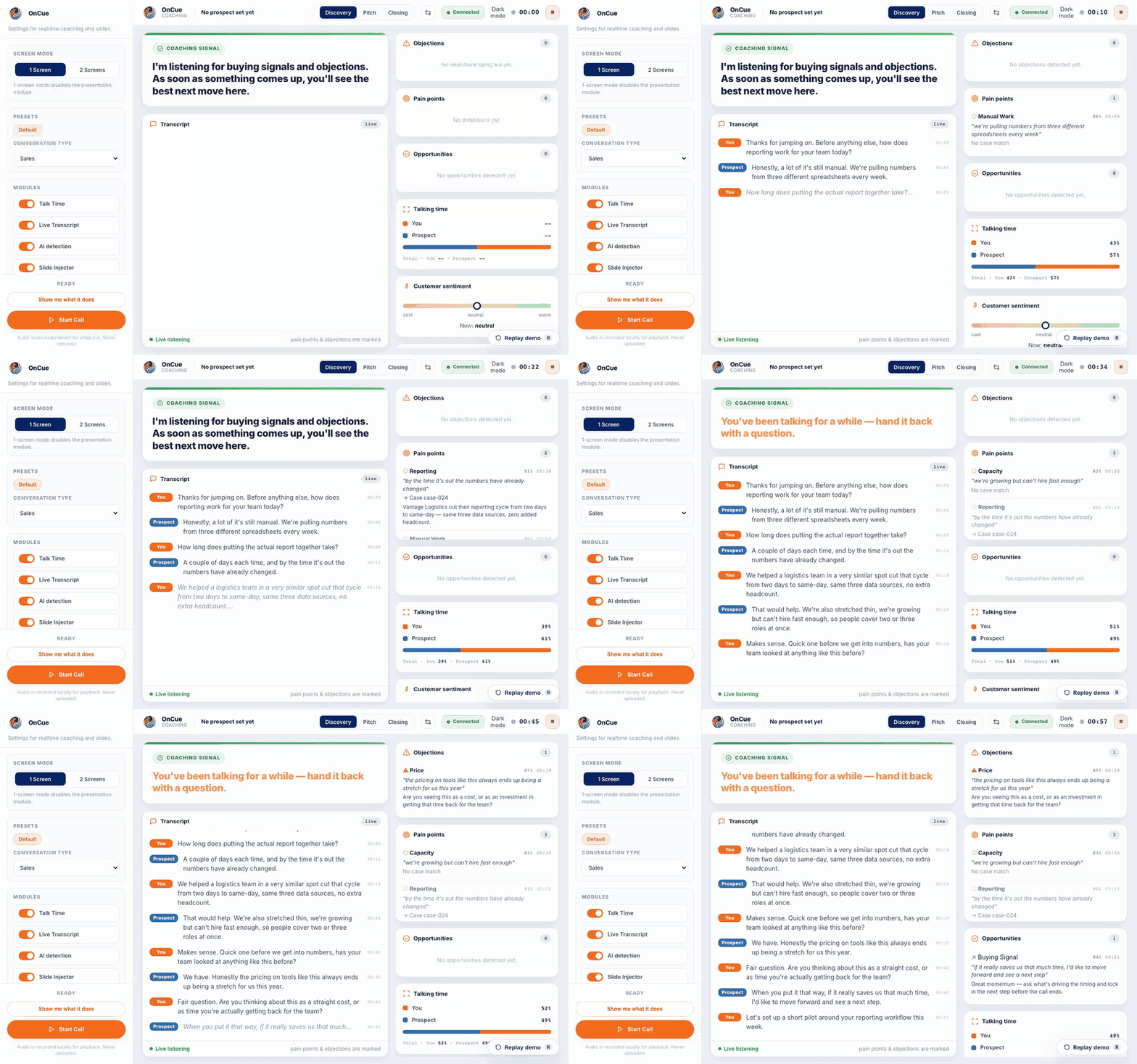
OnCue transcribes live on your own machine, flags pain points and objections as they land, hands you the line to say, and drops the matching case slide into your deck. While you are still talking.
Built on open, inspectable technology
Five things running while you talk.
No summary the next morning. Detection, coaching and case content, live in the conversation.
Live transcription, included
Your microphone and system audio get transcribed on your own machine with whisper.cpp. Real-time local transcription is something teams pay for separately. Here it is part of the core, and it feeds every detection below.
Pain point detection, 12+ categories
The transcript is matched against pain point routes you configure yourself. You see what actually blocks the customer while they are still explaining it, not when you replay the call.
Objections with a line to say
Price, timing, competitor, scope, authority. The moment one lands you get a curated card: say this now. Mark it used or useful and the playbook learns.
Slide injection, timed
A matching case slide appears in your live presentation the second a pain point lands, so you show proof instead of promising it. You switch nothing yourself.
Talk-time coaching
A calm breathing bar on your second screen shows your talk-time balance, with a nudge when you slide into a monologue. It fades in and out. No popups, nothing visible on a shared screen.
The only limit is your hardware. Not your privacy.
Audio capture, transcription and detection run on your own machine by default. Nothing leaves it unless you pick a cloud model yourself, per conversation.
- Audio capture: local, full system tap, recording optional
- Transcription: local, whisper.cpp
- Detection: local embedding path, no language model needed
- Open source under AGPL-3.0: read it, run it, fork it, no lock-in
You pick the tier per conversation.
Local is the default. Cloud only when that specific call allows it.
Local (default)
Audio, transcription and detection run on your machine. Nothing leaves it. This is the default for sensitive or regulated calls.
Free tierYour own cloud tenant (BYOK)
Bring your own key: Azure OpenAI, Vertex or Bedrock, under your own governance. Local for capture and detection, your tenant for the heavier steps. Data stays inside a cloud boundary your organisation already manages.
Sweet spot for regulated teamsPublic cloud (opt-in)
Route a single call through a public API such as OpenAI or OpenRouter. Opt-in per conversation. Useful for internal meetings or sales training without regulated client data.
Never the defaultThe same person can run one call fully local and the next through their own cloud tenant. It is a per-call choice, not a per-customer setting.
The core is free. Forever.
Free is a complete product on its own. Sales Pro adds the live coaching layer.
| Feature | FreeSelf-hosted | Sales ProFrom EUR 29 | EnterpriseBy arrangement |
|---|---|---|---|
| Core engine | |||
| Live local transcription (whisper.cpp) | ✓ | ✓ | ✓ |
| Pain point detection, 12+ categories | ✓ | ✓ | ✓ |
| Objection detection | ✓ | ✓ | ✓ |
| Local audio recording, optional | ✓ | ✓ | ✓ |
| Meet, Zoom, Teams and phone | ✓ | ✓ | ✓ |
| Live coaching | |||
| Curated rebuttal playbook (say this now) | — | ✓ | ✓ |
| Slide injection into a live deck | — | ✓ | ✓ |
| Talk-time breathing bar + monologue nudge | — | ✓ | ✓ |
| Card feedback: used / useful, the playbook learns | — | ✓ | ✓ |
| Compliance & operations | |||
| 100% local mode | ✓ | ✓ | ✓ |
| BYOK: your own Azure / Vertex / Bedrock key | ✓ | ✓ | ✓ |
| Central audit trail across a team | — | ✓ | ✓ |
| Consent registration per session | ✓ | ✓ | ✓ |
| Licence & support | |||
| Licence | AGPL-3.0 | Commercial | Commercial |
| Support | Community | Onboarding, model tuning | |
Second screen. Four steps.
Open OnCue next to your call
OnCue runs on your second screen while you are in Meet, Zoom, Teams or on the phone. The prospect sees nothing.
It listens and transcribes locally
Mic and system audio go into whisper.cpp on your machine. The transcript builds up as you talk.
Signals appear as they land
Pain points, objections and buying signals land in the side rail, with the curated line you can use right now.
You show proof and keep the balance
The matching case slide drops into your deck, and the breathing bar keeps your talk-time in check. After the call you get a summary and a report.
The same local pipeline. Other conversations.
The same on-device capability, applied to other conversation types. Sales stays what I build OnCue for. Detection, transcription and coaching fit here too.
Coaching and performance reviews
OnCue transcribes locally and tracks the talk-time balance, so the conversation does not tip to one side.
Interviews and recruitment
The transcript builds live, so you can listen instead of type and keep a clean record afterwards.
Deep-dive and user-research interviews
Recurring themes and pain points surface while the participant is talking, not when you replay the recording.
1:1s and mentoring
The breathing bar shows who is holding the floor, with a calm nudge when you talk too long yourself.
Consulting discovery calls
Pain points and signals get detected locally, so the scope becomes clear during the call itself.
Customer success and support calls
Concerns and objections appear the moment they land, with a summary and report afterwards.
Start free. Pay when live coaching earns it.
Free
The open source, self-hosted core. Complete on its own.
- Live local transcription
- Pain point and objection detection
- 100% local, BYOK optional
- AGPL-3.0, fork it
Sales Pro
Everything in Free, plus the layer that coaches you during the call.
- Curated rebuttal playbook
- Slide injection during the call
- Talk-time coaching
- Central audit trail
Enterprise
For teams that need a guided rollout on their own cloud tenant.
- Onboarding and rollout
- Support with response times
- Model tuning on your own calls
- Custom integrations
OnCue is also used for coaching reviews and recruitment conversations. Ask me if that is relevant for your team.


The questions that come up first.
Is it really local?
Which platforms does it work with?
Is it open source?
Do I need a strong machine?
Does the other person notice anything?
Be there when the first version goes live.
Leave your email and you will hear it before it opens up. No spam, no games with a limited number of seats.